
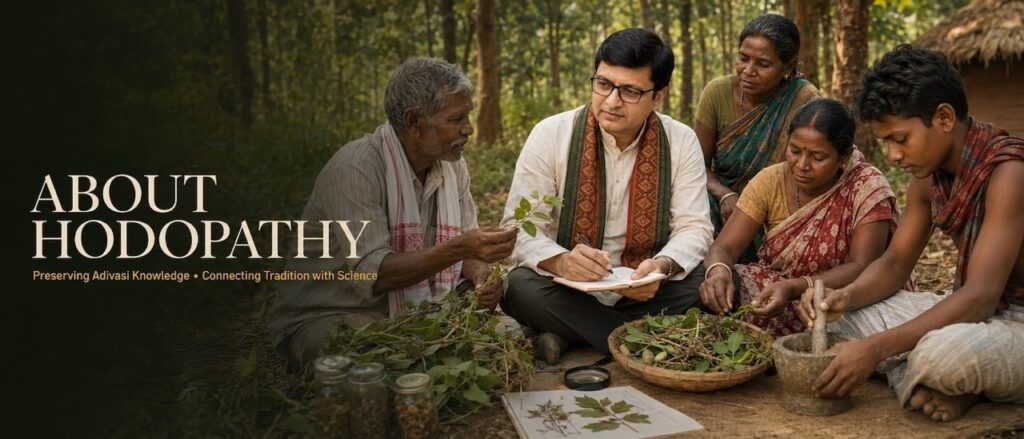
About Hodopathy
Preserving Adivasi Knowledge and Connecting Traditional Wisdom with Responsible Research
Hodopathy is an indigenous knowledge tradition associated particularly with the Ho community and other Adivasi communities of Jharkhand. It reflects generations of understanding developed through close interaction with forests, medicinal plants, seasonal foods, natural resources and community life.
Traditionally, this knowledge has been preserved through oral teaching, observation and practical experience. Elders and traditional knowledge holders have carried it from one generation to the next, often without written records or formal documentation.
Hodopathy.com is a knowledge-preservation, documentation and research initiative created to help safeguard this living heritage. It provides a responsible platform where Adivasi knowledge holders, traditional practitioners, researchers, botanists, universities and conservation organisations can connect and collaborate.
More Than Knowledge of Medicinal Plants
Hodopathy should not be understood merely as a collection of herbs or traditional preparations. It represents a wider relationship among people, plants, forests, culture and community well-being.
This knowledge may include an understanding of:
-
Native plants and forest resources
-
Traditional methods of identifying useful plants
-
Seasonal collection and preparation practices
-
Local foods and community nutrition
-
Sustainable use of natural resources
-
Conservation of forests and biodiversity
-
Cultural beliefs connected with nature and well-being
-
Knowledge transmitted through families and traditional practitioners
Every plant, practice and preparation exists within a specific cultural and ecological context. Preserving Hodopathy therefore also requires preserving the stories, languages, communities and natural environments connected with it.
Why Hodopathy Needs Documentation
A large part of Hodopathy remains in oral form. It is held in the memories and practical experiences of elders, traditional practitioners and Adivasi families living across different villages and forest regions.
As experienced knowledge holders grow older, younger generations migrate and natural habitats decline, valuable knowledge faces the risk of disappearing. Once an undocumented tradition is lost, it may be impossible to recover.
Responsible documentation can help preserve this heritage for future generations. However, documentation must be carried out with the knowledge and participation of the communities concerned. Sacred, confidential or restricted knowledge should never be disclosed without permission.
Hodopathy.com seeks to create a respectful record without removing knowledge from its cultural roots or separating it from its original custodians.
What We Do
Our work focuses on four interconnected areas:
Knowledge Documentation
We record permitted oral histories, community experiences, plant knowledge, local terminology, traditional practices, photographs and field observations.
Research Facilitation
We encourage responsible interaction between traditional knowledge holders and researchers for botanical identification, literature review, laboratory investigation and scientific evaluation.
Knowledge Preservation
We work toward creating an organised archive that can protect valuable information from being forgotten, distorted or represented without its proper cultural context.
Ecological Conservation
We promote awareness about native plants, medicinal-plant cultivation, sustainable harvesting, biodiversity protection and the importance of conserving Jharkhand’s forests.
These activities are intended to build a reliable foundation for cultural preservation, education and future research.
A Bridge Between Communities and Institutions
Traditional knowledge holders possess generations of practical experience, while scientific institutions offer systematic methods of identification, analysis, testing and documentation.
Hodopathy.com aims to create a constructive bridge between these two knowledge traditions.
The platform seeks to connect:
-
Adivasi elders and community knowledge holders
-
Traditional Hodopathy practitioners
-
Botanists and ethnobotanical researchers
-
Universities and research institutions
-
Laboratories and scientific organisations
-
Biodiversity and forest-conservation groups
-
Students and responsible documentarians
-
Organisations working for indigenous rights
Such collaboration can help traditional knowledge receive serious academic attention while ensuring that communities remain recognised and involved.
Modern science should not be used to displace indigenous wisdom, and traditional experience should not be presented as scientifically proven without proper evaluation. Both must be approached honestly, respectfully and responsibly.
Community Knowledge, Community Identity
The knowledge associated with Hodopathy is part of the collective cultural heritage of the communities that have preserved it. These communities should not be treated merely as sources of information, photographs, plants or raw materials.
Knowledge holders deserve dignity, acknowledgement and meaningful participation in any documentation or research connected with their traditions.
Hodopathy.com does not claim ownership over the collective wisdom of Adivasi communities. Its role is to support its preservation, encourage responsible study and help ensure that the identity of its original custodians is neither ignored nor erased.
Tradition with Responsibility
Traditional knowledge can provide important directions for research, but traditional use alone does not automatically establish the safety or effectiveness of a plant or preparation.
Correct botanical identification, appropriate quantities, preparation methods, contamination risks, interactions and individual health conditions all require careful consideration.
Hodopathy.com therefore clearly distinguishes among:
-
Community knowledge and oral tradition
-
Documented historical or ethnobotanical use
-
Preliminary laboratory findings
-
Scientifically established evidence
We do not encourage self-medication or the use of unidentified plants. Information published on this website is intended for cultural preservation, education and research awareness. It must not be interpreted as medical advice or used as a substitute for diagnosis and treatment by a qualified healthcare professional.
Preserving Knowledge Without Exploiting It
The future of Hodopathy depends on an approach that respects both cultural heritage and community rights.
Preservation should not become extraction. Documentation should not lead to unauthorised ownership. Research should not exclude the people whose knowledge made that research possible.
Through ethical participation, careful documentation and responsible collaboration, Hodopathy can be studied and preserved without losing its identity.
A Living Platform for the Future
Hodopathy.com is envisioned as a growing knowledge platform where heritage, communities, conservation and research can come together.
It is a space for learning from the past while working responsibly for the future—a future in which indigenous knowledge is documented accurately, traditional practitioners are treated with dignity, forests and native plants are protected, and scientific inquiry proceeds with honesty.
We invite knowledge holders, researchers, institutions and responsible individuals to participate in this journey of documentation, preservation and learning.
Together, we can help ensure that Jharkhand’s valuable Adivasi knowledge is neither forgotten nor separated from the people and landscapes that have protected it for generations.
Hodopathy — Preserving Adivasi Knowledge, Protecting Living Heritage and Encouraging Responsible Research.